
Best Wi-Fi Mesh Systems
As an Amazon Associate, I earn from qualifying purchases. Some links may earn us a commission at no extra cost to you.
Mesh Wi-Fi setups range from ready-made multi-node kits to expandable routers that can become part of a larger mesh network. The right option depends on home size, internet speed, wired-network requirements, and whether you value a complete kit or prefer to build the system gradually.
Top 8 Picks
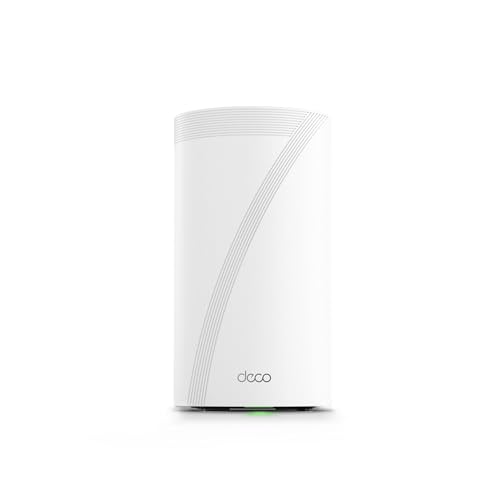
1. TP-Link Deco BE85 — Wi-Fi 7 With 10GbE Connectivity
The Deco BE85 is a tri-band Wi-Fi 7 mesh platform rated as BE22000. The supplied listing includes two 10Gbps ports, two 2.5Gbps ports, wired-backhaul support, eight high-gain antennas, AI roaming, VPN features, and HomeShield.
This campaign entry is a one-pack, so it makes more sense as a high-performance starting node or addition to a compatible Deco system than as a complete multi-node kit by itself.
Why consider it: Its combination of Wi-Fi 7 and high-speed Ethernet is aimed at multi-gigabit home networks.

Pros
- Tri-band Wi-Fi 7
- Two 10Gbps Ethernet ports
- Two additional 2.5Gbps ports
- Supports wired backhaul
- AI-roaming features
Cons
- Supplied as a one-pack
- Hardware may be unnecessary for slower internet plans
Trade-offs / Who should skip: Choose a complete two- or three-node kit if you need broad mesh coverage immediately rather than building the system around individual units.
2. TP-Link Deco XE200 — Two-Node Wi-Fi 6E With 10GbE
The Deco XE200 is an AXE11000 tri-band Wi-Fi 6E mesh system supplied as a two-pack. Its listing includes a 10Gbps Ethernet port and positions the package as a replacement for a traditional router-and-extender arrangement.
The 6GHz band gives compatible Wi-Fi 6E devices another wireless band to use while the two-node format provides a complete mesh starting point.
Why consider it: It combines a two-node Wi-Fi 6E system with 10Gbps wired connectivity.

Pros
- Tri-band Wi-Fi 6E
- Two mesh units included
- 10Gbps Ethernet port
- Complete two-node package
- Alexa compatibility listed
Cons
- Does not provide Wi-Fi 7
- 6GHz signals generally have shorter range through walls
Trade-offs / Who should skip: Homes without Wi-Fi 6E devices or multi-gigabit networking may not benefit from all of its hardware.
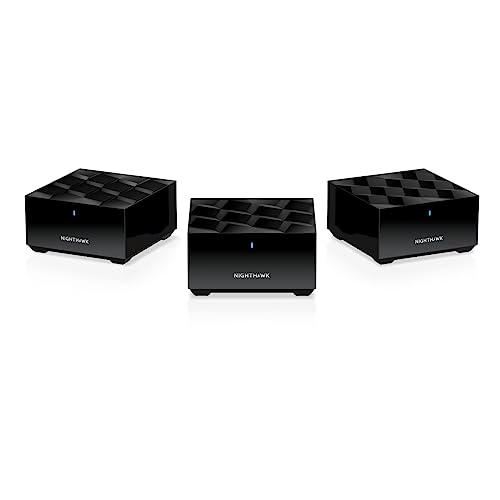
3. NETGEAR Nighthawk MK63S — Three-Node Wi-Fi 6 for Everyday Homes
The original Nighthawk MK63S returns to the lineup as a straightforward three-piece Wi-Fi 6 system. It includes one router and two satellites using dual-band AX1800 Wi-Fi 6.
NETGEAR rates the kit for up to 4,500 square feet and at least 25 connected devices. Its role is everyday streaming, browsing, video calls, smart-home devices, and general household connectivity rather than high-end multi-gigabit networking.
Why consider it: The three-unit package provides broad Wi-Fi 6 coverage without requiring separate mesh nodes to be added later.
Pros
- Router and two satellites included
- Dual-band Wi-Fi 6
- Up to 4,500 sq. ft. manufacturer-rated coverage
- Compact nodes
- Designed for typical household connectivity
Cons
- No dedicated wireless backhaul band
- Gigabit wired connectivity limits multi-gigabit upgrades
Trade-offs / Who should skip: Choose a tri-band, Wi-Fi 6E, or Wi-Fi 7 option if your network has heavier traffic or faster-than-gigabit requirements.
4. Tenda Nova MX12 — Three-Node AX3000 Wi-Fi 6
The Nova MX12 is a three-piece AX3000 Wi-Fi 6 mesh system. It supports OFDMA, MU-MIMO, beamforming, WPA3, and band steering, while every unit provides three Gigabit Ethernet ports.
Ethernet backhaul is supported, making the system especially useful in homes where the nodes can be connected with existing network cabling.
Why consider it: It provides three AX3000 Wi-Fi 6 nodes and flexible wired-backhaul support.

Pros
- Three AX3000 mesh nodes
- Wi-Fi 6
- Three Gigabit Ethernet ports per unit
- Ethernet backhaul support
- WPA3 support
Cons
- No dedicated wireless backhaul band
- Gigabit Ethernet limits multi-gigabit wired speeds
Trade-offs / Who should skip: A tri-band mesh system may be preferable when all nodes must communicate wirelessly and network traffic is heavy.
5. ASUS RT-BE86U — Wi-Fi 7 Mesh-Compatible Multi-Gigabit Router
The ASUS RT-BE86U brings another brand and a different deployment style into the lineup. It is a Wi-Fi 7 router rated in the supplied listing for up to 6.8Gbps and includes one 10G port plus four 2.5G ports.
The listing also identifies it as mesh-compatible and includes VPN support, parental controls, and subscription-free network-security features.
Why consider it: It offers Wi-Fi 7 and extensive multi-gigabit Ethernet for buyers who want to build an expandable mesh-compatible network.

Pros
- Wi-Fi 7
- 10G Ethernet port
- Four 2.5G ports
- Mesh-compatible design
- VPN support
- Subscription-free security features listed
Cons
- Single router rather than a complete mesh kit
- Additional compatible hardware is required for multiple-node coverage
Trade-offs / Who should skip: Choose the Nighthawk, Deco XE200, Tenda MX12, or AmpliFi HD if you specifically want multiple nodes included in the box.
6. AmpliFi HD WiFi System — Router Plus Two Mesh Points
The AmpliFi HD package uses a central router and two dedicated mesh points for whole-home coverage. The supplied listing also includes four Gigabit Ethernet ports on the router, one WAN port, and an Ethernet cable.
Its hardware represents a more traditional mesh approach than the newer Wi-Fi 6E and Wi-Fi 7 products, but the full multi-node package is ready to deploy without separately purchasing expansion points.
Why consider it: It provides a complete router-plus-two-mesh-point system from a different networking ecosystem.

Pros
- Router plus two mesh points
- Four Gigabit Ethernet ports
- Dedicated WAN port
- Complete multi-node package
- Designed to replace router-and-extender setups
Cons
- Listing does not state Wi-Fi 6, Wi-Fi 6E, or Wi-Fi 7
- Gigabit wired connectivity is not designed for multi-gigabit networks
Trade-offs / Who should skip: Choose a newer Wi-Fi generation if support for current high-speed wireless clients matters more than the bundled three-piece configuration.
7. UeeVii WR3000K — AX3000 Mesh-Capable Router
The UeeVii WR3000K is an AX3000 Wi-Fi 6 router with a six-antenna dual-band design. Its supplied listing specifically includes wireless-bridge and access-point operation along with one-click WPS and mesh functionality.
Unlike the ready-made three-node systems, this is a single-device starting point intended for a more flexible network build.
Why consider it: It adds an AX3000 mesh-capable option for buyers who want router, bridge, and access-point flexibility.
No products found.
Pros
- AX3000 Wi-Fi 6
- Mesh functionality stated in the listing
- Wireless bridge mode
- Access-point capability
- Six-antenna design
Cons
- Single unit rather than a multi-node package
- Smaller brand ecosystem than the major networking manufacturers
Trade-offs / Who should skip: Choose an established multi-node kit if simple whole-home setup and a larger support ecosystem matter more than deployment flexibility.
8. Tenda Nova MW12 — Three-Node Tri-Band Coverage
The Nova MW12 is supplied as a three-pack and is identified in the listing as an AC2100 tri-band whole-home mesh system. Tenda claims coverage of up to 6,000 square feet and support for more than 100 connected devices.
The listing also specifies three Gigabit Ethernet ports, making this a broad-coverage alternative for households that prioritize multiple nodes and tri-band operation over having the newest Wi-Fi generation.
Why consider it: Three nodes and tri-band operation give it a distinct large-layout role in the lineup.

Pros
- Three mesh units
- AC2100 tri-band platform
- Up to 6,000 sq. ft. claimed coverage
- Listed for more than 100 devices
- Three Gigabit Ethernet ports
Cons
- Older wireless generation than Wi-Fi 6, 6E, and 7 systems
- Gigabit Ethernet limits wired multi-gigabit use
Trade-offs / Who should skip: Choose one of the Wi-Fi 6 or Wi-Fi 7 systems if newer client support and faster wired networking are higher priorities.
Quick Compare
- Wi-Fi 7 with 10GbE: TP-Link Deco BE85
- Two-node Wi-Fi 6E with 10GbE: TP-Link Deco XE200
- Three-node everyday Wi-Fi 6: NETGEAR Nighthawk MK63S
- Three-node AX3000 Wi-Fi 6: Tenda Nova MX12
- Wi-Fi 7 mesh-compatible router: ASUS RT-BE86U
- Router plus two dedicated mesh points: AmpliFi HD WiFi System
- AX3000 flexible mesh-capable router: UeeVii WR3000K
- Three-node tri-band coverage: Tenda Nova MW12
Final Verdict
This revised lineup spreads the eight slots across six networking brands rather than concentrating most of the article around only a few manufacturers.
The Deco BE85 and ASUS RT-BE86U emphasize Wi-Fi 7 and multi-gigabit wired networking, while the Deco XE200 provides a complete two-node Wi-Fi 6E setup. The restored NETGEAR Nighthawk MK63S and Tenda Nova MX12 provide ready-made three-node Wi-Fi 6 alternatives for more conventional home networks.
AmpliFi HD offers a router-plus-mesh-point architecture, UeeVii provides a flexible mesh-capable AX3000 starting point, and the Tenda MW12 supplies a three-node tri-band option for broader coverage.
As an Amazon Associate, I earn from qualifying purchases.