
Best Front and Back Dash Cam (Front + Rear Coverage)
As an Amazon Associate, I earn from qualifying purchases. Some links may earn us a commission at no extra cost to you.
Front-and-rear dash cams vary considerably in resolution, parking features, storage, screen design, connectivity, and whether they also record the cabin. The right setup depends on whether you prioritize maximum detail, simpler daily use, extended parking coverage, or additional interior recording.
Top 7 Picks
1. VIOFO A229 Pro 2CH — 4K Front and 2K Rear Recording
The VIOFO A229 Pro pairs 4K front recording with a 2K rear camera and uses Sony STARVIS 2 sensors on both channels.
It also supports HDR, 5GHz Wi-Fi, GPS, and memory cards up to 512GB. Its screen-free design keeps the main camera relatively discreet, with settings and footage management handled through the connected interface.
Why consider it: Its 4K/2K dual-camera configuration emphasizes image detail from both directions.

Pros
- 4K front and 2K rear recording
- Dual STARVIS 2 sensors
- HDR support
- 5GHz Wi-Fi
- Supports up to 512GB storage
Cons
- No built-in viewing screen
- More settings-oriented than very simple plug-and-record models
Trade-offs / Who should skip: The A229 Plus offers a similar dual-camera format at lower resolution, while screen-equipped options such as the Pelsee may be easier for drivers who want controls directly on the camera.
2. DDPAI Z60 — Built-In Storage and Extended Parking Features
The DDPAI Z60 combines 4K front recording with a 1080p rear camera and includes both 32GB of built-in eMMC storage and a 64GB card.
It supports cards up to 512GB and adds 5GHz Wi-Fi, GPS, a 3-inch IPS display, G-sensor recording, ADAS, and DDPAI’s advertised seven-day AOV parking feature.
Why consider it: Built-in eMMC storage gives it an additional recording option beyond a removable memory card.

Pros
- 4K front and 1080p rear
- 32GB built-in eMMC storage
- 64GB card included
- 5GHz Wi-Fi and GPS
- 3-inch IPS screen
Cons
- Rear resolution is lower than the front camera
- ADAS and extended parking features add more settings to manage
Trade-offs / Who should skip: Choose a dual-2K or 4K/2K system if rear-camera resolution matters more than built-in storage and parking-oriented features.
3. VIOFO A229 Plus 2CH — Dual 2K Front and Rear Setup
The A229 Plus uses 1440p recording at both the front and rear rather than prioritizing a 4K front channel.
It retains much of the same platform as the A229 Pro, including STARVIS 2 sensors, HDR, GPS, and 5GHz Wi-Fi.
That makes it a useful alternative for drivers who prefer balanced resolution from both cameras.
Why consider it: Both front and rear cameras record at 2K, giving the system a more even dual-channel configuration.

Pros
- 2K front recording
- 2K rear recording
- STARVIS 2 sensors
- HDR support
- GPS and 5GHz Wi-Fi
Cons
- Front footage has less resolution than a 4K model
- No built-in display
Trade-offs / Who should skip: Move to the A229 Pro if maximizing front-camera resolution is the priority.
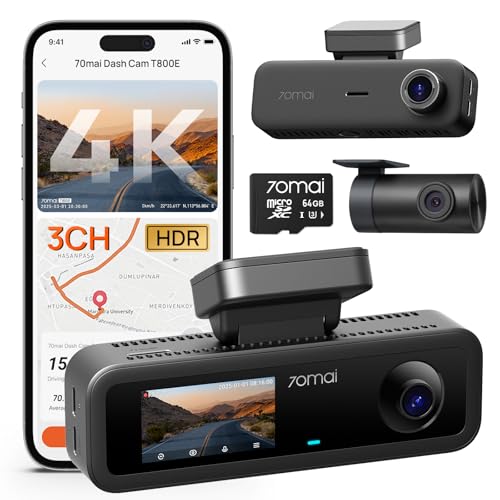
4. 70mai T800E — Three-Channel Front, Rear, and Cabin Coverage
The 70mai T800E adds an interior camera to the usual front-and-rear arrangement.
Its listing specifies 4K recording along with three-channel front, rear, and inside coverage. It also includes GPS, Wi-Fi 6, voice control, parking monitoring, night vision, loop recording, and a 64GB memory card.
Why consider it: The additional cabin channel provides broader coverage for rideshare drivers, families, and anyone who wants interior recording.

Pros
- Three-channel recording
- 4K front-camera specification
- GPS
- Wi-Fi 6
- 64GB card included
Cons
- Three cameras mean more installation and cabling
- Interior recording is unnecessary for drivers who only want exterior coverage
Trade-offs / Who should skip: Choose a two-channel system such as the VIOFO models, DDPAI Z60, Cobra SC 250R, or Pelsee S3 if cabin footage is not useful to you.
5. Cobra SC 250R — Connected Front-and-Rear Dash Cam
The Cobra SC 250R is a dual-view front-and-rear system with true 4K resolution listed for the main camera.
Its feature set includes 360 Alerts, Parking Live View, incident reports, Emergency Mayday, and integration with CarPlay and Android Auto. A 32GB memory card is included.
This makes it more connectivity-focused than a basic record-and-save dash cam.
Why consider it: It combines front/rear recording with a broader set of connected driving and incident features.

Pros
- True 4K specification
- Front and rear coverage
- Parking Live View
- Incident and Emergency Mayday features
- CarPlay and Android Auto support
Cons
- More connected features than some drivers need
- Included 32GB card is smaller than the cards bundled with several alternatives
Trade-offs / Who should skip: A simpler VIOFO or ROVE setup may be preferable if you mainly want local video recording rather than connected services.
6. Pelsee S3 Touch — STARVIS 2 Camera With Touch Display
The Pelsee S3 Touch combines 4K front-and-rear dash-cam functionality with a Sony STARVIS 2 sensor and a 3.39-inch IPS display.
Its listing also includes full-color night-vision technology, Wi-Fi 6, GPS, ADAS, voice control, and 24-hour parking mode. A 128GB card is included.
The built-in display gives it a different user experience from screen-free models.
Why consider it: It combines a touch-oriented display with STARVIS 2 imaging and a large included memory card.

Pros
- 4K front-and-rear system
- STARVIS 2 sensor
- 3.39-inch IPS screen
- Wi-Fi 6 and GPS
- 128GB card included
Cons
- Screen makes the camera more visually noticeable
- ADAS, voice control, and parking features may be more than a basic user needs
Trade-offs / Who should skip: Choose a more discreet screen-free model if minimizing the camera’s visible footprint is more important than on-device controls.
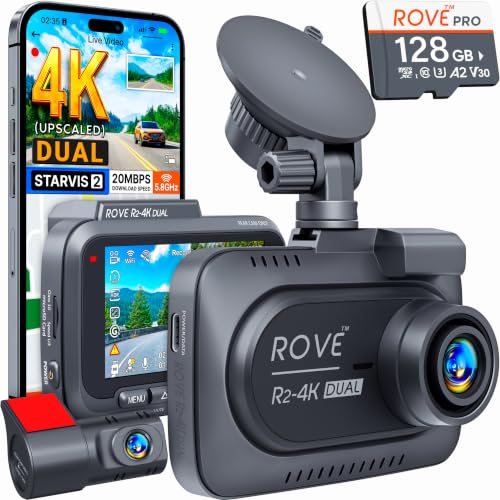
7. ROVE R2-4K Dual — Straightforward 4K/1080p Dual-Camera Setup
The ROVE R2-4K Dual provides 4K front recording with a 1080p rear camera.
It includes GPS, Wi-Fi, an on-body screen, and a 128GB memory card, making it a relatively straightforward option for drivers who want the essential front-and-rear features in one package.
The main compromise is the lower-resolution rear camera compared with dual-2K or 4K/2K systems.
Why consider it: It provides 4K front recording, rear coverage, GPS, Wi-Fi, a screen, and included storage in a simple package.
Pros
- 4K front recording
- 1080p rear camera
- GPS and Wi-Fi
- Built-in screen
- 128GB card included
Cons
- Rear camera is limited to 1080p
- Lower rear detail than dual-2K and 4K/2K alternatives
Trade-offs / Who should skip: Choose the A229 Plus or another higher-resolution dual system if rear-camera detail is especially important.
Quick Compare
- VIOFO A229 Pro 2CH — 4K front and 2K rear with dual STARVIS 2 sensors
- DDPAI Z60 — 4K/1080p dual system with eMMC storage and extended parking features
- VIOFO A229 Plus 2CH — balanced 2K front and 2K rear recording
- 70mai T800E — three-channel front, rear, and cabin coverage
- Cobra SC 250R — dual-camera setup with connected alerts and parking features
- Pelsee S3 Touch — STARVIS 2 system with IPS display and 128GB included storage
- ROVE R2-4K Dual — straightforward 4K/1080p setup with GPS, Wi-Fi, and included memory card
Final Verdict
These seven dash cams address different priorities rather than offering the same configuration at different prices.
The VIOFO A229 Pro emphasizes high-resolution two-channel recording, while the A229 Plus provides balanced 2K footage from both directions. The DDPAI Z60 adds built-in eMMC storage and a stronger emphasis on extended parking functions.
The 70mai T800E adds cabin recording for drivers who need three-channel coverage. Cobra’s SC 250R focuses more heavily on connected alerts and incident features, while the Pelsee S3 Touch provides a screen-based interface with STARVIS 2 imaging and substantial included storage.
The ROVE R2-4K Dual remains a simpler 4K-front/1080p-rear alternative for drivers who want front-and-back recording without moving into a more elaborate multi-camera system.
As an Amazon Associate, I earn from qualifying purchases.