
Best 4K Projectors for a Cinematic Home Setup
As an Amazon Associate, I earn from qualifying purchases. Some links may earn us a commission at no extra cost to you.
A strong 4K projector depends on more than headline brightness. Contrast, HDR support, throw distance, lens controls, gaming performance, built-in streaming, and room conditions all affect the final picture. These eight options cover dedicated movie viewing, high-refresh gaming, ultra-short-throw installations, flexible placement, and premium all-in-one setups.
Top 8 Picks
1. Valerion VisionMaster Pro2 — Triple-Laser Projector With Optical Zoom
The VisionMaster Pro2 combines a 4K RGB triple-laser light engine with a 0.9–1.5:1 optical zoom range. That gives it more physical placement flexibility than lifestyle projectors that rely primarily on digital correction.
Its original listing also includes Dolby Vision, HDR10+, IMAX Enhanced, Filmmaker Mode, active 3D, HDMI 2.1 connectivity, and low-latency gaming modes.
Why consider it: Its combination of triple-laser projection, HDR formats, optical zoom, and gaming features suits mixed movie-and-gaming setups.

Pros
- 3,000-ISO-lumen triple-laser system
- 0.9–1.5:1 optical zoom
- Dolby Vision, HDR10+, and IMAX Enhanced
- HDMI 2.1 and low-latency gaming modes
Cons
- Does not offer extensive traditional projector lens shift
- Fastest gaming modes use lower resolutions rather than 4K/120
Trade-offs / Who should skip: A projector with extensive lens shift may be easier to integrate into a fixed theater with a difficult mounting position.
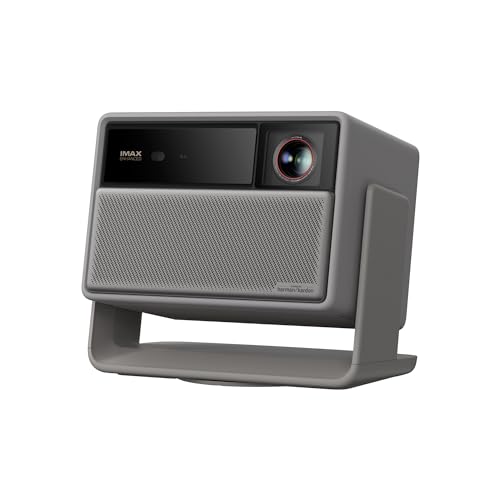
2. XGIMI HORIZON 20 Pro — High-Brightness Gaming and Mixed-Use Setup
The HORIZON 20 Pro uses an RGB triple-laser system rated at 4,100 ISO lumens. Optical zoom plus horizontal and vertical lens shift provide more installation flexibility than most all-in-one smart projectors.
Gaming features include VRR, ALLM, and low-latency modes, while movie support includes Dolby Vision, HDR10+, and IMAX Enhanced. Google TV handles integrated streaming.
Why consider it: High listed brightness, lens shift, optical zoom, and gaming features make it well suited to mixed-use rooms.
Pros
- 4,100-ISO-lumen rating
- Optical zoom and lens shift
- VRR and ALLM
- Dolby Vision and HDR10+
- Google TV
Cons
- 4K gaming is limited to 60Hz
- Maximum-brightness operation can increase noise and affect color accuracy
Trade-offs / Who should skip: Gamers specifically requiring 4K/120 should look beyond this group rather than relying on its lower-resolution high-refresh modes.
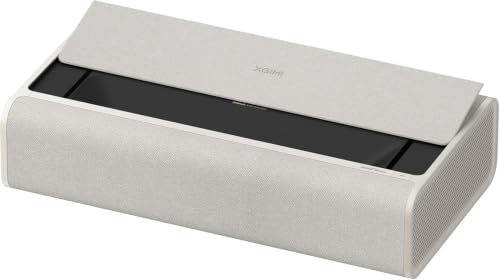
3. XGIMI AURA 2 — Ultra-Short-Throw Living-Room Setup
The AURA 2 uses a 0.177:1 throw ratio, allowing it to create a large image while sitting close to the wall. That makes it suitable for living rooms where a conventional projector cannot be mounted across the room.
Its original listing includes Dolby Vision, HDR10, HLG, IMAX Enhanced, Google TV with licensed Netflix, and four Harman Kardon speakers.
Why consider it: Ultra-short-throw placement allows a large-screen setup without mounting a projector at the back of the room.
Pros
- 0.177:1 ultra-short throw
- Dolby Vision and IMAX Enhanced
- Google TV with licensed Netflix
- Integrated Harman Kardon audio
Cons
- Best ambient-light performance requires a UST-specific ALR screen
- Placement must be precise to keep the image properly aligned
Trade-offs / Who should skip: A standard-throw projector provides more placement choices if you already have a conventional ceiling or rear-room mounting position.
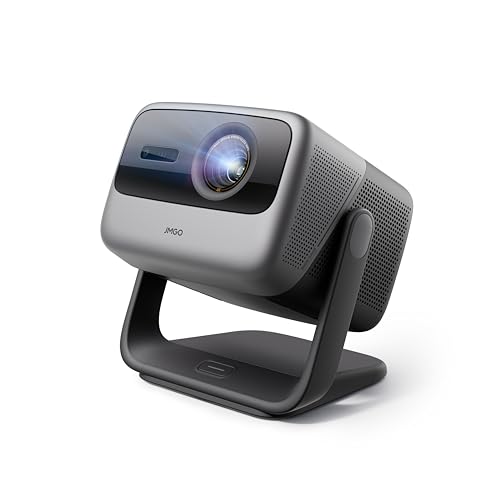
4. JMGO N1S Ultimate — Integrated Gimbal for Flexible Placement
The JMGO N1S Ultimate combines 4K triple-laser projection with an integrated gimbal that can rotate and tilt. This makes changing projection direction easier without installing a separate adjustable mount.
Its original listing specifies 3,300 ISO lumens, Google TV with native Netflix, automatic focus, keystone correction, and image adaptation.
Why consider it: The integrated gimbal is useful when the projector needs to be repositioned between rooms or projection surfaces.
Pros
- Rotating and tilting gimbal
- 3,300-ISO-lumen triple-laser system
- Google TV with Netflix
- Automatic focus and image adjustment
Cons
- Heavy digital correction can reduce effective image sharpness
- Less gaming-focused than the dedicated high-refresh options
Trade-offs / Who should skip: A permanently mounted theater projector makes more sense if the unit will never need to be repositioned.
5. ViewSonic LX700-4K — High-Refresh Laser Gaming
The ViewSonic LX700-4K is built around bright laser projection and high-refresh gaming. It supports 4K at 60Hz, 1440p at 120Hz, and up to 1080p at 240Hz.
The original listing also specifies 3,500 ANSI lumens, a 1.3x optical zoom, and a 4.2-millisecond mode at 1080p/240Hz.
Why consider it: Its resolution and refresh-rate options give PC and console gamers more flexibility than a cinema-only projector.


Pros
- 4K/60 support
- 1440p/120Hz
- 1080p/240Hz
- 4.2ms mode at 1080p/240Hz
- 1.3x optical zoom
Cons
- No built-in smart streaming platform
- Does not provide lens shift or 4K/120
Trade-offs / Who should skip: A smart all-in-one model may be more convenient if gaming performance is secondary to integrated streaming.
6. Nebula X1S — High-Output Triple-Laser Smart Projector
The Nebula X1S combines 4K triple-laser projection with a listed 6,000 ANSI lumens and 56,000:1 dynamic contrast. Its optical system uses a 14-element all-glass lens and includes optical zoom.
The supplied listing also specifies Google TV, Dolby Vision, AI spatial adaptation, and a 40W Dolby audio system.
Why consider it: Its combination of high listed brightness, optical zoom, Dolby Vision, Google TV, and substantial integrated audio creates a feature-heavy all-in-one setup.

Pros
- 4K triple-laser projection
- Listed at 6,000 ANSI lumens
- Optical zoom
- Dolby Vision and Google TV
- 40W Dolby audio
Cons
- Extensive smart and AI features may be unnecessary in a fixed theater using external source equipment
- Integrated 40W audio adds less value if a separate home-theater sound system is already installed
Trade-offs / Who should skip: A simpler cinema-focused projector may be more appropriate if streaming, onboard audio, and automatic room adaptation will not be used.
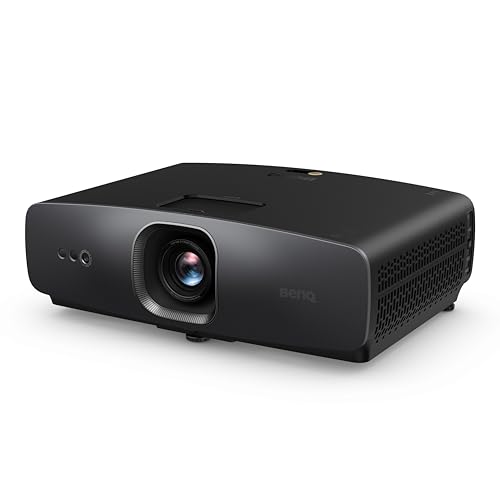
7. BenQ W2720i — Color-Focused Home-Theater Projector
The BenQ W2720i is positioned specifically around home-theater viewing. Its supplied listing specifies 4K projection, 2,500 lumens, and coverage of 95% of the DCI-P3 color space.
It also includes HDR10 and HLG support, AI Cinema Mode, Android TV, and a Dolby Atmos speaker.
Why consider it: Its DCI-P3 coverage and cinema-oriented processing make it a distinct choice for viewers prioritizing movie presentation over maximum feature count.
Pros
- 4K home-theater design
- 95% DCI-P3 color coverage
- HDR10 and HLG
- AI Cinema Mode
- Android TV
Cons
- Supplied listing does not emphasize high-refresh gaming features
- Cinema-oriented features may be unnecessary for casual TV and streaming use
Trade-offs / Who should skip: A gaming-focused ViewSonic or brighter all-in-one laser model may fit better when movies are not the main use.
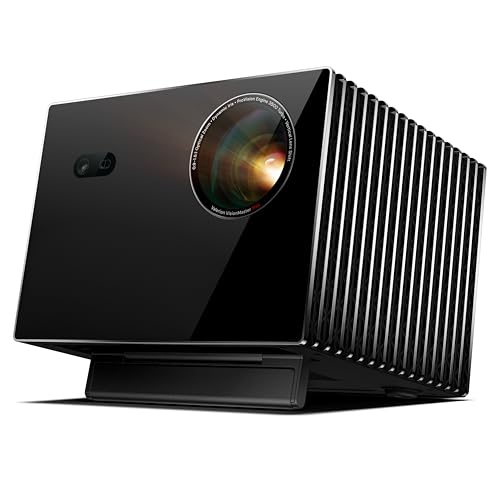
8. Valerion VisionMaster Max — Flagship Laser Features and High-Refresh Gaming
The VisionMaster Max sits above the Pro2 in Valerion’s supplied campaign lineup. Its listing specifies a 4K laser system rated at 3,500 ISO lumens along with anti-RBE and speckle-reduction features.
It also includes a 0.9–1.5:1 optical zoom range, IMAX Enhanced, HDR10+, 3D, Gigabit connectivity, and a listed 4ms/240Hz gaming mode.
Why consider it: It expands on the VisionMaster formula with higher listed brightness and additional image-artifact reduction features.
Pros
- 3,500-ISO-lumen 4K laser system
- 0.9–1.5:1 optical zoom
- Anti-RBE and speckle-reduction features
- IMAX Enhanced and HDR10+
- Listed 4ms/240Hz gaming mode
Cons
- Significant feature overlap with the VisionMaster Pro2
- Supplied listing does not specify lens shift
Trade-offs / Who should skip: The Pro2 remains the simpler fit if you do not need the Max model’s higher listed brightness or additional anti-RBE and speckle-reduction features.
Quick Compare
- Triple-laser movies and gaming: Valerion VisionMaster Pro2
- Brightness, lens shift, and gaming: XGIMI HORIZON 20 Pro
- Ultra-short-throw living-room installation: XGIMI AURA 2
- Flexible gimbal positioning: JMGO N1S Ultimate
- High-refresh laser gaming: ViewSonic LX700-4K
- High-output smart triple-laser setup: Nebula X1S
- Color-focused home theater: BenQ W2720i
- Flagship laser and gaming features: Valerion VisionMaster Max
Final Verdict
These eight projectors cover substantially different installations and priorities. The VisionMaster Pro2 balances cinema features, optical zoom, and gaming, while the HORIZON 20 Pro adds lens shift and higher listed brightness for mixed-use spaces.
The AURA 2 addresses ultra-short-throw installations, the JMGO N1S Ultimate focuses on repositioning flexibility, and the ViewSonic LX700-4K emphasizes high-refresh gaming.
Among the additions, the Nebula X1S combines high listed brightness with Google TV and integrated audio, the BenQ W2720i emphasizes cinema-oriented color and HDR features, and the VisionMaster Max expands Valerion’s premium laser lineup with additional image-artifact reduction and gaming features.
Room layout, screen type, ambient light, gaming requirements, and whether you prefer integrated streaming or external equipment should determine which configuration fits your setup.
As an Amazon Associate, I earn from qualifying purchases.