
Guitar Tuners for Accurate Everyday Tuning
As an Amazon Associate, I earn from qualifying purchases. Some links may earn us a commission at no extra cost to you.
A good guitar tuner should be easy to read, respond quickly, and fit the way you actually play. Clip-on models are convenient for practice and acoustic instruments, pedal tuners integrate neatly into electric-guitar rigs, while automatic tuners can handle both pitch detection and physical string adjustment.
These seven options cover precision strobe tuning, rechargeable clip-ons, large displays, noisy practice spaces, pedalboards, and automatic tuning.
Top 7 Picks
1. Peterson StroboClip HD — High-Precision Strobe Tuning
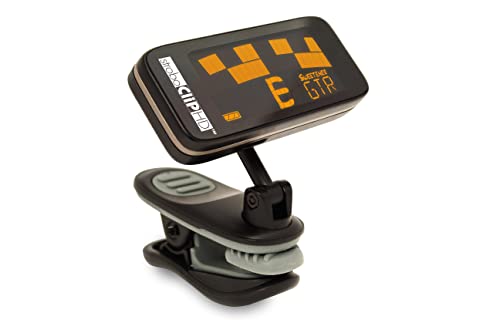
The Peterson StroboClip HD is built for players who want finer pitch feedback than a conventional needle-style tuner. Peterson rates it to one-tenth-cent accuracy and includes more than 50 Sweetened Tuning presets for different instruments and tuning approaches.
Its true-strobe display makes small pitch changes easier to see, while the padded clip senses instrument vibration directly through the headstock.
Why consider it: Its strobe display and fine stated accuracy suit setup work, recording preparation, and players who want detailed pitch feedback.
Pros
- Rated to ±0.1 cent accuracy
- True-strobe display
- More than 50 tuning presets
- Padded headstock clamp
- Supports multiple instrument types
Cons
- Strobe display takes some familiarization
- More settings than casual players may need
- Uses a replaceable coin-cell battery
Trade-offs / Who should skip: A simpler clip-on makes more sense if you mainly need fast everyday tuning and do not need strobe-level precision.
2. D’Addario Nexxus 360 — Rechargeable 360° Clip-On
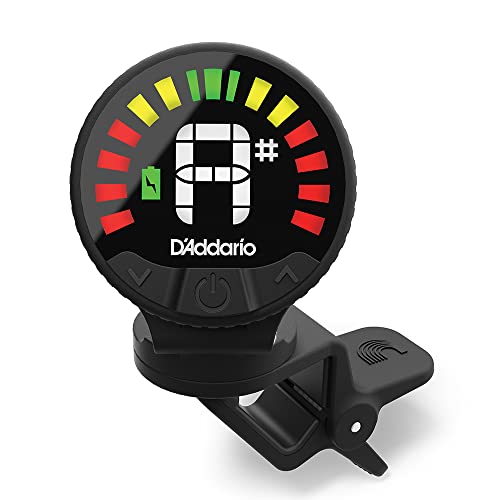
The D’Addario Nexxus 360 combines a rechargeable design with a head that rotates through 360 degrees. The supplied listing states up to 24 hours of tuning per charge.
Its compact clip-on format is intended for acoustic and electric guitar and avoids the recurring coin-cell replacements common with many small tuners.
Why consider it: Rechargeable operation and full-angle positioning make it convenient for routine practice and repeated use.
Pros
- Rechargeable battery
- Up to 24 hours per charge
- 360-degree rotating head
- Clip-on format
- Suitable for acoustic and electric guitar
Cons
- Requires periodic recharging
- Listing does not specify strobe-level precision
Trade-offs / Who should skip: Choose the Peterson if extremely fine tuning feedback matters more than rechargeable convenience.
3. Roadie 4 Automatic Tuner — Motorized Tuning and String Winding
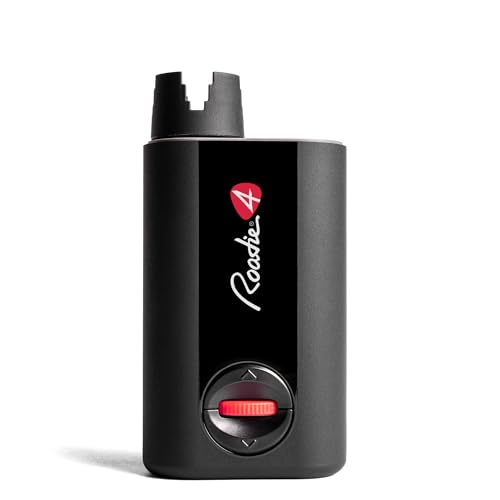
The Roadie 4 takes a different approach from a conventional display tuner. It detects pitch and automatically turns the machine head to adjust the string.
The supplied listing also includes a built-in metronome and string-winder function, and it supports acoustic, electric, and 12-string guitars as well as banjo and mandolin.
Why consider it: Automatic tuning and string winding reduce the amount of manual peg adjustment required.
Pros
- Automatic motorized tuning
- Built-in string winder
- Built-in metronome
- Supports 12-string guitars
- Works with several fretted instruments
Cons
- More complex than a basic clip-on
- Larger and more expensive than conventional tuners
Trade-offs / Who should skip: A clip-on tuner is simpler if you prefer to adjust tuning pegs manually or want something that can stay attached to the headstock.
4. KLIQ TinyTune Pro — Compact Pedalboard Tuner
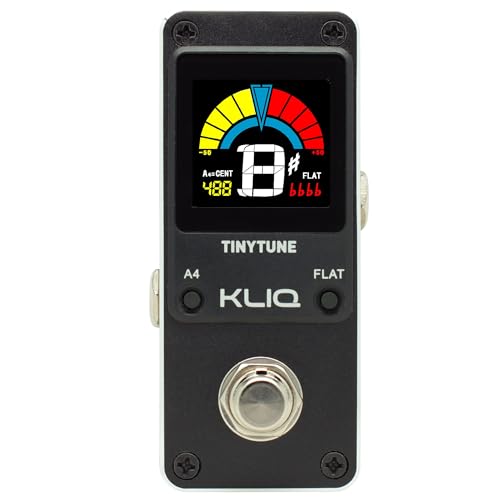
The KLIQ TinyTune Pro is a mini chromatic tuner pedal intended for electric guitar and bass rigs.
Its supplied listing includes true bypass, silent switching, flat-tuning support, an LED display, and pitch calibration. It requires a 9V power supply.
Why consider it: Its pedal format provides silent tuning and keeps the tuner permanently available within an electric-guitar signal chain.
Pros
- Compact pedal design
- True bypass
- Silent tuning switch
- Flat-tuning support
- Pitch calibration
Cons
- Requires a 9V power supply
- Less convenient for acoustic instruments without a pickup
Trade-offs / Who should skip: Choose a vibration-sensing clip-on if you regularly tune unplugged acoustic instruments away from a pedalboard.
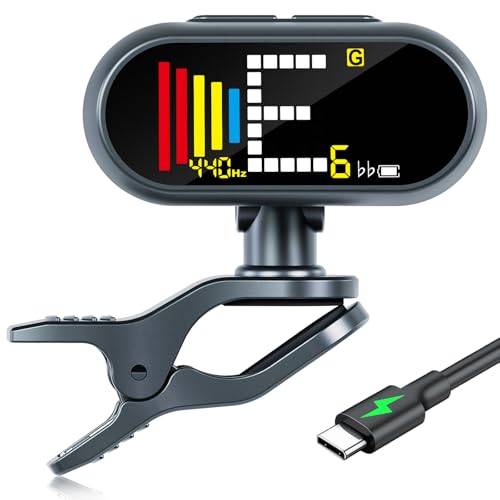
5. EX USB-C Clip-On Tuner — Large Color Display
The EX clip-on tuner emphasizes visibility with a 1.97-inch color LCD. Its supplied listing specifies ±1-cent accuracy, USB-C recharging, and a clip that rotates through 360 degrees.
It supports acoustic and electric guitar, bass, ukulele, and violin through a chromatic tuning format.
Why consider it: The relatively large color screen is useful for players who find compact tuner displays difficult to read.

Pros
- 1.97-inch color LCD
- Listed ±1-cent accuracy
- USB-C rechargeable
- 360-degree rotating clip
- Multi-instrument chromatic tuning
Cons
- Larger display makes it less discreet than micro tuners
- Less precise on paper than the Peterson strobe model
Trade-offs / Who should skip: Players prioritizing the smallest possible headstock footprint may prefer a more compact clip-on.
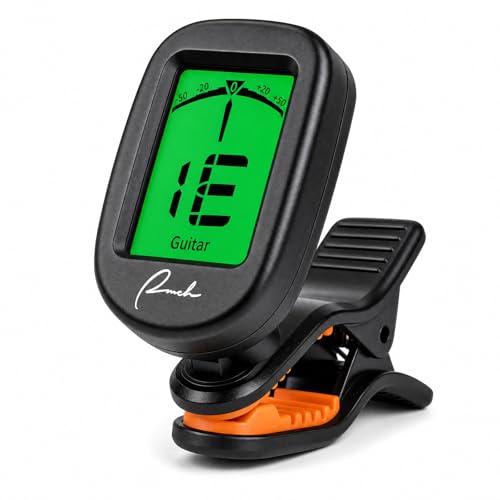
6. Ranch Clip-On Tuner — Vibration-Based Multi-Instrument Tuning
The Ranch tuner uses vibration sensing rather than depending only on room sound, which helps when tuning in a noisy practice environment.
Its supplied listing includes chromatic operation, a 360-degree rotating display, and compatibility with guitar, bass, ukulele, violin, and banjo.
Why consider it: Vibration-based detection and a rotating display provide a straightforward everyday tuning setup for several instruments.
Pros
- Vibration-based detection
- 360-degree rotating display
- Chromatic tuning
- Supports multiple instruments
- Simple clip-on design
Cons
- No rechargeable battery is stated in the supplied listing
- Does not offer the Peterson’s strobe-style precision features
Trade-offs / Who should skip: A rechargeable model may be more convenient if you want to avoid replaceable batteries.
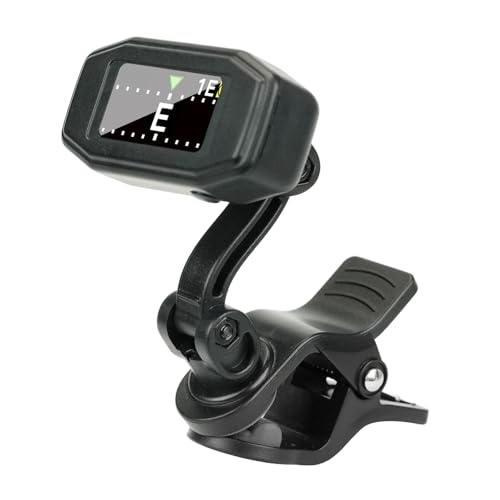
7. AROMA Rechargeable Tuner — TFT Display for Brighter Conditions
The AROMA clip-on is a rechargeable chromatic tuner for guitar, bass, ukulele, violin, and mandolin.
Its supplied listing specifically highlights a TFT display designed to remain easy to read in strong light, giving it a useful role for brighter rooms or daytime playing.
Why consider it: The TFT screen is positioned around improved visibility when ambient lighting is strong.
Pros
- Rechargeable design
- TFT display
- Designed for strong-light readability
- Chromatic tuning
- Supports several stringed instruments
Cons
- Supplied listing does not specify strobe-level accuracy
- Another rechargeable clip-on may be redundant if you already own one
Trade-offs / Who should skip: The EX may suit players prioritizing a larger screen, while the Peterson is better suited to users seeking finer pitch feedback.
Quick Compare
- Fine strobe tuning: Peterson StroboClip HD
- Rechargeable 360° clip-on: D’Addario Nexxus 360
- Automatic tuning and string winding: Roadie 4
- Pedalboard tuning: KLIQ TinyTune Pro
- Large color display: EX USB-C Clip-On
- Vibration-based everyday tuning: Ranch Clip-On
- TFT display for brighter conditions: AROMA Rechargeable Tuner
Final Verdict
These seven tuners cover noticeably different workflows. The Peterson StroboClip HD emphasizes fine pitch feedback, while the D’Addario Nexxus 360 provides a rechargeable everyday clip-on format.
The Roadie 4 adds automatic machine-head adjustment and string winding, while the KLIQ TinyTune Pro fits permanently into an electric guitar or bass pedalboard.
For conventional clip-on tuning, the EX emphasizes a larger color display, the Ranch uses vibration sensing with broad multi-instrument compatibility, and the AROMA focuses on a rechargeable design with a TFT screen intended for visibility in stronger light.
The most useful choice depends on whether you prioritize tuning precision, display size, rechargeable operation, noisy-room performance, pedalboard integration, or automatic string adjustment.
As an Amazon Associate, I earn from qualifying purchases.